


|
|
|
| HomeAbout Billiards DigestContact UsArchiveAll About PoolEquipmentOur AdvertisersLinks |
|
Browse Features
Tips & InstructionAsk Jeanette Lee Blogs/Columns Stroke of Genius 30 Over 30 Untold Stories Pool on TV Event Calendar Power Index |
Current Issue
Setting The Record Straight While 14.1 has faded as a tournament game, Bobby Chamberlain and a few top professionals hope huge high runs will be a way to gain attention for pool's traditional discipline. By Nicholas Leider Straight pool had a nice run. Excusing the pun, the discipline was the chosen game for professional tournaments for most of the 20th century. In the 1920s and '30s, it brought thousands of fans to ballrooms and concert halls to watch world championship matches. In the post-WWII war period, 14.1 was the discipline of Willie Mosconi in real life and The Hustler's Fast Eddie Felson and Minnesota Fats in Hollywood. But as pool evolved and preferences changed, 9-ball became the ascendent TV-friendly format, eventually replacing straight pool as the tournament game in the '70s and '80s. By the time 1986's The Color of Money sparked a massive boost of interest in the sport, Fast Eddie sums up his take on 9-ball on screen: This ain't pool. This is for bangers. Straight pool is pool. This is like handball, or cribbage, or something. Straight pool, you gotta be a real surgeon to get 'em, you know? It's all finesse. Now, everything is 9-ball, 'cause it's fast, good for TV, good for a lot of break shots. Oh well, what the hell? Checkers sells more than chess. Though professional tournaments and world championships in 14.1 continued to be held into the 2000s, it continued to shrink into a more niche game, as 9-ball, 10-ball and even one-pocket took up more bandwidth in the sport's collective attention span. But straight pool is now seeing a bit a resurgence — one specifically focused on massive, world-title-breaking runs. The headlines alone are stunning enough: - In 2019, John Schmidt breaks Mosconi's 65-year-old world record run of 526 by running 626. - Less than three years later, in 2022, Jayson Shaw runs 714, though after review the Billiard Congress of America later sanctioned it as a 669-ball run. - In 2025, Shaw destroys his own high run by setting the new mark at 832. The current run-chasing trend is due in large part to the efforts of Virginia's Bobby Chamberlain, an accomplished straight pool player and successful billiard and spa retailer, who has been working to encourage top professionals to dedicate themselves to straight pool — not in place of 9-ball and other games but as a side venture to test the boundaries of 14.1 and, along the way, bring new fans to the game by creating video content. 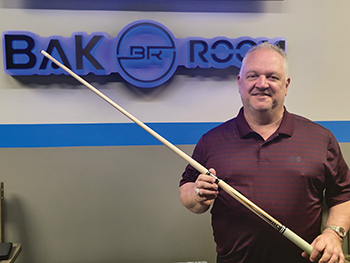 In late 2021, Chamberlain began the Legends of Straight Pool Challenge, which invited world-class professionals to his private room in the Washington, D.C., area to spend days at a time playing straight pool with the explicit goal of setting a new record. “A lot of people have never played straight pool — never seen it,” Chamberlain said, “so my thought process was, if I could get their favorite players where they could see them — you know, the Shane Van Boenings, the Earl Stricklands, the Jason Shaw — and put them on a live stream where [fans] can see them for free, even without completely understanding the game, would they watch? And I felt that they would.” With high run challenges and the resulting video for players and fans to consume online, Chamberlain is hoping to capitalize on the renewed interest in the discipline, even if it is currently more of a spectator sport, with only the best of the best aiming for 833 and beyond. He is currently organizing an event he hopes will attract 12 world champions to his private Bak Room Billiards in Lorton, Va., for an open-house event that will carry a six-figure payday should a player break 1,000, with each competitor spending multiple days chasing huge high runs. Still, the end goal for Chamberlain remains to use these events to bridge straight pool's return to a viable tournament discipline. “The events I've done and that I'm putting together, these are the first steps,” he said. “The whole goal is to try to get a five-year contract with the World Pool Association (WPA) for the official World 14.1 Championship. That will always be the goal.” Challenging Runs Throughout the ebbs and flows in straight pool's popularity, a player's high run still carries weight. It is a numerical shorthand to understand the ability of an individual. Running 100 is a serious achievement players spend decades chasing. Running 421, like BCA Hall of Famer and 14.1 world champ Allen Hopkins, means you're an all-timer. Mosconi's run of 526 stood as the most hallowed number in pool for decades, similar to Wilt Chamberlain's 100-point game and Joe DiMaggio's 56-game hit streak. “[Bobby Hunter] and I were in a poolroom and he was showing me how to play straight pool,” said John Schmidt, in 2019. “The first thing I asked was, 'What's the all-time high run?' I'll never forget it. About nine people in the room all chimed in at the same time, 'Willie Mosconi, 526 balls. Springfield, Ohio. 1954.' I knew right then that this was the record in pool. This was the number everybody knew.” As straight pool's viability as a tournament game waned in the '00s — no WPA-sanctioned world championship was held between 1991-2005, before a brief reprise that ended in 2010 — high run challenges became an alternate route to attract attention and have players give 14.1 a go. Bob Jewett, an accomplished instructor and longtime BD columnist, was inspired to organize a high run challenge at the 2006 Derby City Classic after Earl Strickland argued that offensive straight pool is “the most intelligent pocket billiards game on earth.” “As time went by, I learned more about straight pool by practicing the game more,” Strickland posted to AZBilliards.com. “[It] is a game that tests your character, integrity, and ability to think fast but play deliberate.” Jewett organized the Straight Pool Shootout at the Derby City Classic for five years, adding $10,000 to the prize fund each year. He then handed it off to Dennis Walsh and Bill Maropoulos, who continued it for another nine years, until space and scheduling considerations ended its run in 2019. The event routinely attracted top pros, though it remained on the periphery of all the happenings at the Derby. That same year, though, straight pool would be thrust back into the spotlight with Schmidt's world-breaking run of 626 in May. The 2006 U.S. Open 9-Ball Champion had long had his sights set on Mosconi's 526. Back in 2004, a 400-ball run in Florida earned him the nickname, plainly enough, “Mr. 400.” While world-class in other disciplines, enough to make two Mosconi Cup teams and win the DCC one-pocket event, Schmidt would periodically dedicate time to chasing the straight pool record. That dedication reached another level in 2018 and 2019. In four distinct sessions, lasting between 20 to 29 days with a few off days, he did little else than eat, sleep and play 14.1. As for the motivation? No regrets. “Once I decided to go after the record, I didn't know that I could break it,” Schmidt said at the time. “I just knew that I didn't want to be 80 years old going, 'I think I could have broken the record.' I'd rather say, 'You know, I tried to break the record. I gave it a very valiant effort, but I wasn't good enough.' I would have been happier to say that than think I could've and didn't try. I just wanted to find out. It was a test of what I could do physically and mentally.” On May 27, 2019, Schmidt passed the test, running a century more than Mosconi's 526. Smashing a 65-year-old record, he also showed just what was possible with such single-minded focus. A Lifelong Passion Chamberlain's history with the game starts shortly after he learned to walk. Rolling balls round the table as a toddler, he was never far from pool. But meeting the legendary Luther “Wimpy” Lassiter as an eight-year-old and playing with him through his teens, Chamberlain became an accomplished player who always held an extra appreciation for straight pool. While ditching pool as a financial endeavor and developing a successful pool and spa retail business in the '80s and '90s, Chamberlain always had a question about Mosconi and his high run that has led him to his current endeavors. 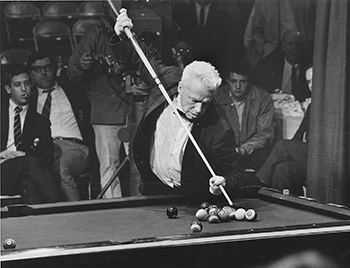 Chamberlain, who was drawn to 14.1 by Lassiter, wonders how many balls Mosconi would have run if he'd set his mind to it. “Mosconi did daily exhibitions for Brunswick for more than 17 years,” he said. “He always promised to run 100, 125 or 150 balls — and whatever he promised, he did. So how many unfinished runs were out there that never got completed? We were doing our math, and we think that Mosconi had approximately 20,000 runs of 100, 125, or 150 and stopped. 20,000 runs. What would have happened if he continued every one of those runs? Would he have run 1,000? Would he have run 1,500?” His first attempt at answering that question — though swapping in today's world-class players — began in November 2021. The Legends of Straight Pool Challenge began with Shane Van Boening spending four days at Chamberlain's room, eventually putting up a high run of 308. Next, Russian pro Ruslan Chinakhov spent two days chasing 626, topping out at 266, before Earl Strickland posted runs of 218 and 238. Jayson Shaw, after a conversation with Chamberlain at the Turning Stone Classic in January 2022, decided to take a run at the record. “I hadn't played straight pool for a long time, but I always knew I was a good shot-maker,” he said. “And, you know, I think if I just played a little bit, I would figure it out. After four days, I ran a lot of balls, constantly running 200 to 300 balls, but I had had enough.” Ready to give up, at least for now, Shaw figured he could take the lessons learned during this cram session and apply it to his next attempt. Luckily for him, though, someone close to him had different ideas. His wife, Ara, asked if he thought he could do it. Jayson: Yeah, I just need a little bit of luck. Ara: Well, let's just stay one more day. Jayson: No, we'll just come back. Ara: No, we'll just stay one more day. With no expectations, Shaw said he felt relaxed at the table and his body was fresh. Playing into the night and early the next morning, he breezed through racks, all while Chamberlain racking, and, by 6 a.m., he pocketed his 627th consecutive ball, eventually missing after a run of 714. 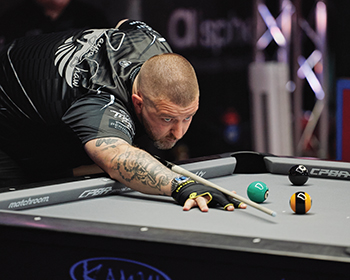 Shaw's astonishing 832-ball run was officially recognized by the Billiard Congress of America as highest ever. Following the run, debate — both online and among pool's decision-makers — arose over a potential foul while Shaw was at 669. Far from conclusive, the video shows the possibility of his shirt coming into contact with an object ball. Though the Billiard Congress of America would eventually tell Shaw and Chamberlain the run could be recognized as 669, the whole scenario left a bad taste in Shaw's mouth. “I grew up playing snooker,” he said. “No matter what you did, a foul was a foul. I'm sure if I would've felt something, that I might've fouled, I would've said something. But that stayed in my mind for a long time. I wanted to go back there and, you know, put it right.” Shaw said he earned a sizeable payday on the heels of his historic run, through prizes and merchandising, and would routinely trek down to Chamberlain's room in the ensuing years to chase a new world record, even without financial incentive. In March 2025, he did just that — running 832 balls in three hours and 40 minutes before erring on a combination in the 60th rack. “He set everything straight with that run,” Chamberlain said. “He beat 669 and 714. And the big thing, he also beat 768, which is what Babe Cranfield [was said to have] did in 1970 in Syracuse, New York.” As for the challenge of running hundreds of balls beyond 526, Shaw laid out the challenges inherent in such an endurance event. “Each session is so, so difficult,” he said. “It's mentally draining, and physically, it's crazy. The amount of pain I was in after that was just insane. I had a sore neck for a long time. My shoulder and my lower back were just screwed. [For the 714 run], I think it was like eight or nine months until my back felt right again. I knew it wasn't going to be easy. I had blisters all over my hands, so there aren't a lot of people that are willing to put themselves through that.” Such Great Heights Chamberlain continues to work to gain attention for straight pool, including the 12-player tournament that will allow each competitor to visit Bak Room Billiards for a set number of days with a set number of innings per day. While still in the early stages of development, the event aims to increase straight pool's profile by offering a six-figure bonus to chase 1,000 balls. “It's also going to create 500-600 hours of live-stream video over the course of a year,” he said, noting all videos will be available free on YouTube. “The average weekend tournament might only get 10 or 20 hours of streaming.” “It's going to gain a lot of interest. This type of event, with the extraordinary money and all the pressure, it's bound to create a lot of chaos and drama.” While critics point out that these accomplishments are done outside of traditional competition, a 500-, 800-, or 1,000-ball run is its own undeniable achievement. “It builds pressure when you get on a big run,” Schmidt said. “I don't care what anybody says — when you're nearing your own high run, you're going to feel pressure. And the more often that you can feel pressure, the more often it feels normal. That's why you see guys that clean windows on skyscrapers. I would have a heart attack doing that, and they do it every day, and so that's what straight pool has done for me.” 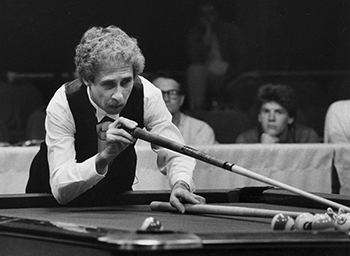 Two-time World 14.1 Champion Varner considers Shaw's run far superior to Mosconi's. Nick Varner, BCA Hall of Famer and 14.1 world champion with a high run of 337 (which he did twice), sees 14.1 challenge events for what they are — something different than traditional matches but not wholly different. “These high run contest and tournament pool — they are two different things, because if you miss [in a challenge format], it doesn't cost you anything and your opponent isn't going to run out.” “You got to play a lot faster, because of the time frame. It's a little more about momentum than controlling the game. To run those high runs, at least to me, it's mentally a different thing.” While comparing the two approaches to straight pool can be a little apples-to-oranges, Varner is crystal clear how he views Shaw's performance compared to Mosconi's 526. “I'd say Jayson's [accomplishment] is way better,” he said. “Number one, it's on a 9-foot table and he ran more balls. But to me, I watched the 714-ball run and he did that all in 2 hours, 39 minutes. That's pretty amazing. To me, the speed was more impressive. It was amazing how fast he got through those racks.” Whatever amount of attention these monumental efforts and crooked numbers attract, Chamberlain remains focused on using them as leverage to grow the interest in straight pool throughout the sport. “Straight pool has lost its recognition as the greatest game, so my thought process is, how can I get the most amount of people to watch and get involved in straight pool?” With interest at the room level well below what it was 40 or even 20 years ago, a top-down approach with the world's greatest doing unbelievable things may be worth a shot. |
|
Since 1978, Billiards Digest magazine has been the pool world’s best source for news, tournament coverage, player profiles, bold editorials, and advice on how to play pool. Our instructors include superstars Nick Varner and Jeanette Lee. Every issue features the pool accessories and equipment you love — pool cues, pool tables, instruction aids and more. Columnists Mike Shamos and R.A. Dyer examine legends like Willie Mosconi and Minnesota Fats, and dig deep into the histories of pool games like 8-ball, 9-ball and straight pool.
Copyright © 1997 - 2025 Billiards Digest
All Rights Reserved
Luby Publishing, Inc.
310 Busse Highway PBM #319 | Park Ridge, IL 60068
Phone: 312-341-1110 | Fax: 312-341-1469