


|
|
|
| HomeAbout Billiards DigestContact UsArchiveAll About PoolEquipmentOur AdvertisersLinks |
|
Browse Features
Tips & InstructionAsk Jeanette Lee Blogs/Columns Stroke of Genius 30 Over 30 Untold Stories Pool on TV Event Calendar Power Index |
Current Issue
“I'm Doing What I Can While I Can.” The greatest women's pool champion of all time is facing her toughest challenge yet. By Michael Geffner Life is such a fragile thing. In an instant, a single twitch out of nowhere, a persistent cough, a suddenly drooping eye, and your whole world can turn upside down forever. For Allison Fisher, 58, the greatest female pool player of her generation, if not of all-time, her disturbing odyssey began nearly two years ago, with something so mundane as chugging a can of soda. She noticed that her left, gripping hand was trembling uncontrollably. That's weird, she thought. What in the world is that? With a mixture of fascination and fear, she continued staring at her wildly quivering limb. Is it some kind of muscle spasm? Am I tired? She knew something was wrong. Very wrong. It's 10 o'clock in the morning. Allison has already been awake for around four hours. She went to the market to shop for groceries, done laundry, did some housecleaning, tended to her two dogs, Franky and Buddy, and ate an egg-and-toast breakfast with a side of fresh fruit — pineapple, cantaloupe, strawberries, and blueberries. “I've always been an early riser,” she says, adding quickly: “I'm not great at sitting still.” She is seated at a table in her massive sandy-colored, three-level home along the largest lake in North Carolina — Lake Norman — in the serene suburb of Denver. She shares the house with her life partner of nine years, Debra Powell, nicknamed Dee, 57, a physician's assistant, and her 86-year-old mom Christine, who moved in from East Sussex, England, nearly three years ago. “My mom,” she says, “is such a great source of relentless positivity, inspiration and zest for life. I'm very lucky. She's a keeper.” (Her father Peter, a marine and cop, died in 2001 at 64.) Allison is wearing beige pants and a blue T-shirt. Like a true Brit, she is sipping on a cup of tea. She could easily pass for someone at least ten years her junior. With strikingly blue eyes and stylishly cropped blond hair, she is still elegantly beautiful. This is not an easy subject to talk about, such a grave disease — her disease — still fresh and something that will never go away. Her words, though straightforward at first, will eventually turn emotional. She is nothing like her famous deadpan game face in real life. Quite the opposite, she is light-hearted, fun-loving and joyful, with an easy smile, big laugh and a great sense of humor. Yet, over the course of three hours or so, she will softly weep at times and break down crying a couple more times, eventually going completely silent and needing a break for about half a minute. This kind of breakdown is a new facet of her personality. 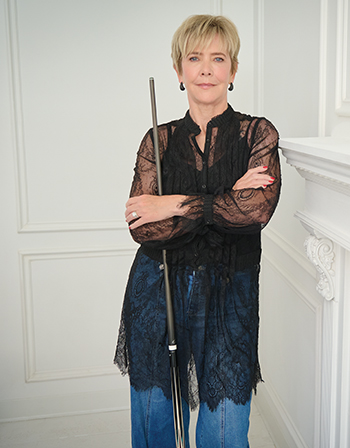 (Photo By Larry Busacca) Allison had been holding back two huge secrets for nearly a year now, staying silent except for those closest to her. She is a private person. She does not like talking publicly about her life away from the game. She was not ready until now to reveal anything so personal. Yet here she is, freely telling all, explaining her long absence from competing in tournaments and ending the gossip about where she has been. As is her nature, she has done things at her own pace, on her own terms. Typically, in complete control. She needed time to digest what would be the most difficult phase of her life, a major change like no other she has ever faced. “It's all about timing,” she says. Sadly, Allison has been diagnosed not once but twice with Parkinson's Disease, an incurable, progressive neurological disorder that affects nerve cells in the brain. It prematurely and abruptly ended her epic 30-year playing career. Without any grand announcements or fanfare, the iconic Duchess of Doom retired oh-so-quietly last December. Only her family and a handful of friends knew, and they knew exactly why, leading to likely the most uncelebrated end of an era in the game's history. She played her final matches in Jacksonville, Florida, the WPA Women's World 9-Ball Championship and the Jax Mixed Doubles Open, both part of the Predator Tour. Just an hour before her doubles match, after getting checked out at the prestigious Mayo Clinic, coincidentally also in Jacksonville, she found out the worst news possible for the second time, the final judgement, confirming what she dreaded for months. She had Parkinson's, no equivocation. “I knew the first diagnosis was correct,” Dee says. “She was hoping it wasn't. She needed that second opinion. She was questioning it.” Her Parkinson's was obvious at tournaments. “People could see my left arm shaking — even though I was trying to hide it,” Allison says. “I was holding back tears while in the chair and walking around the table. Pool playing is about control. I didn't have that control anymore.” Even old game footage showed her gait was “obviously off” for years, Dee says. “She probably had it then.” Parkinson's will affect Allison's movements for the rest of her days. She will need to take medication daily to control it. She will need to monitor it constantly. She will visit the doctor frequently for reevaluations. It will always loom. “She's trying to figure out who she is if she's not playing pool anymore,” Dee says. “Before the Parkinson's, she was struggling with the decision of when to retire because of her age. Suddenly, the decision was made for her. That was hard on her.” Initially, after getting a battery of tests in July 2024 by a neurologist in Charlotte, Allison had been completely cleared her of having anything serious, including being told outright that she did not have Parkinson's. She always had her doubts. For the longest time, she suffered from constant arm pain, difficulty lifting and twisting both arms, those awful tremors. It was so bad it forced her to miss a couple of tournaments. In a bit of denial, she dismissed her issues to nothing more than menopause and old age. “I simply took some Ibuprofen and forgot about it. I let it go,” she says. But her problems continued, if not worsened. She went to another neurologist in Charlotte about a year later, with Dee by her side. “My hope was, it was more benign,” Dee says. “But as she was taking the exam and failing each test, I'm saying to myself, ‘Oh, gosh, that's not good…Ok, that's not good…Oh, that's not good.' There was impending doom. I have enough medical experience to know what the doctor was going to say before he came back.” The doctor's verdict was indeed Parkinson's. “It was a gut-punch,” Allison says. “I was in shock, devastated. I collapsed. I'm not a crier by nature, but I cried a lot that day, especially when I was alone, and a lot since. It's a very unpredictable disease. It could go in so many ways. I could be incapacitated at any time. While it doesn't affect your life span, it does affect your quality of life.” 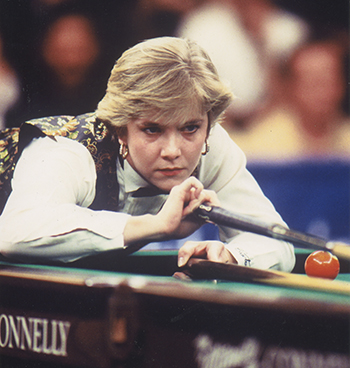 Snooker ace Fisher hit the 9-ball scene with a vengeance. One of Allison's first calls to share her bad news was to her close friend and fellow woman Hall of Fame pro Kelly Fisher, 48, who is also from England. Each consider the other a sister. They have known each other for decades. They often kidded about growing old together on tour, pushing each other around a pool table in wheelchairs. “It's going to be a shock to the (pool) world,” Kelly says. “Of course, she'll handle everything like the champion that she is. It's like playing pool, making the most of what you have and not dwelling on missed shots or a player getting lucky. You move on. You can't change the past; you can't predict the future.” How Allison collected herself emotionally to play so well in those final events, knowing for certain now that she had PD, knowing this was the absolute end of her playing career, is something of a miracle, a testament to her mental strength. “It wasn't easy,” Allison admits. She was so fatigued prior to the tournament that she considered pulling out of the singles to concentrate only on the doubles division. “I didn't feel like I had the stamina,” she says. Dee talked her out of it. “Don't be silly,” she remembers Dee texting her. “It's your last tournament. You're going to dig hard. You're a champion. Play your heart out and give it all you got.” So, in the end, “I just tried to enjoy it,” Allison says. Summoning up the last gasp of whatever was left of her will to win as much as her legendary talent, Allison finished an astonishing third in the World Championship, then incredibly won the 10-ball mixed doubles with partner Jesús Atencio. “It was magical,” she says. “The chemistry was brilliant.” She and Jesús beat everyone from the Fillers to Jayon Shaw/Savannah Easton. “I was thrilled,” Allison says. She will never forget the 3-10 combo she made to win the set against Jayson/Savannah and that long bank on the 10 ball to keep them in the match and a high-pressure winning shot against Yu Han/Albert Januarta. “I said to myself, ‘This is it. This is the perfect way to end my career.' I wanted to go out on a good note.” Allison is in the early stage of Parkinson's, and she is also dealing with the annoying effects of advanced age, menopause and zero hormones. She has her tremors. She gets tired easily. She has brain fog. She can be apathetic at times. Her left forearm is weak. Sometimes her joints feel stiff, sometimes painful. She has trouble getting solid sleep, and, worst of all, has fallen into such deep depressions, “I didn't want to live anymore, I didn't care, and that's not me,” she says. “I'm an upbeat person, a glass-half-full type.” To control her PD, especially the tremors, Allison takes a tablet called Levodopa/Carbidopa, the gold-standard for Parkinson's, twice a day — once in the morning and another around lunchtime — each dose lasting about four hours and providing dopamine to her brain. Dopamine is a neurotransmitter that plays a vital role in many bodily functions, such as motion, memory, motivation, mood, focus, how we feel pleasure. “[The medication] definitely makes me feel more normal,” she says. She is also doing hormone replacement therapy for her menopause. “It sucks getting old,” she says with a chuckle, forcing herself to make light of her situation. Her humor, especially her ability to be self-deprecating, has always been one of her greatest gifts. Former actor Michael J. Fox is, of course, the most recognizable face of Parkinson's. Fox has become a hero, role model and inspiration to those afflicted with PD. He founded his own PD research foundation, named after him, “dedicated to finding a cure,” and oversees an all-encompassing website exclusively about PD with info and news “you can trust.” Many of us have agonized — even wept — seeing Fox in a wheelchair, struggling so hard and needing help from others to get up from chair, walking bent over and with great difficulty using a cane, his twitching fingers, having those excruciating-looking, non-stop tremors, even straining to talk. The late icons, boxer Muhammad Ali and singer Ozzy Osbourne both famously suffered from the disease as well. Singer Carly Simon revealed she had PD in late July. About 1.1 million Americans are now living with the condition, 10 million worldwide. “My doctor warned me not to go down the Parkinson's rabbit hole, to stick to Michael J. Fox's website,” she says. “I'm not dwelling on it. I'm trying my best to live in the moment. To be present. Stay in the present. That's all you can do, I guess. I don't look to the future.”  Fisher teamed with Jesus Atencio to win the PBS Mixed Doubles title in Jacksonville in 2025. Allison's mantra these days is: Take each day as it comes, which translates into spending more time with family, doing more of what she truly enjoys, and creating more memorable moments. Starting a whirlwind of traveling following her PD diagnoses, Allison and the family took a Spring Break cruise in June, aboard Royal Caribbean's Icon of the Seas, the largest cruise ship in the world. They went to such exotic places as Costa Maya, Roatán, Cozumel, and CocoCay. The most memorable moment was scuba diving in Cozumel. They explored underwater tunnels, encountered barracudas, moray eels, giant lobsters, stingrays, turtles, and even sharks. “Without a doubt, my favorite dive to date,” she says. “What an experience. And sharing it with my loved ones (including her two teenaged children – son Pierson and daughter Lilly) made it even more special.” In July, she and Dee were off to England to see Allison's older brother David, a civil engineer, get married at the Royal Pavilion in Brighton (another older brother, Simon, died in 2010 at just 46), as well as visit Big Ben, The House of Lords and The Tower of London. Then she and the kids went off to Italy to see the ancient city of Pompei, the scenic island of Capri, and of course Rome. In Rome, they went on a sightseeing tour of a lifetime on their own: The Colosseum, Saint Peter's Basilica, The Vatican, The Pantheon. “I never did so much walking in my life,” Allison says. “My feet were killing me.” She also did a dive into the dazzling, crystalline waters of Sorrento. From there, she and Dee went to the Hawaiian island of Oahu a couple of months later to see Pearl Harbor. “I love adventure, and I love travel,” she says. “Now I have the time to do both.” She adds bittersweetly: “I'm doing what I can while I can.” Fisher was born on February 24, 1968, in Cheshunt, in Hertfordshire, England. She later lived in Surrey in South England, then Peacehaven, East Sussex. She started playing snooker at seven years old. She saw her dad watching snooker on TV and “I liked the look of it,” she says. There were no role female models in snooker. Until Allison. She ascended quickly. She was a top player by 13. “I grew up with two older brothers,” she says. “It made me very competitive. And I loved what I did, put the work in, and my will to win was strong.” Her snooker career, from 1982 to 1995, was marked by utter dominance, with world titles in 1985, 1986, 1988, 1989, 1991, 1993 and 1994. “But I couldn't see the next five years,” she says. “The way the women were treated so terribly at the World Championship (1994, in New Delhi, India). After it was postponed and postponed and postponed, we ended up playing in this crappy little room, with 120-degree heat and drenched in humidity. It was nothing less than a sweat fest. After the event, she made the statement: “This is the last time you will see me play snooker.” 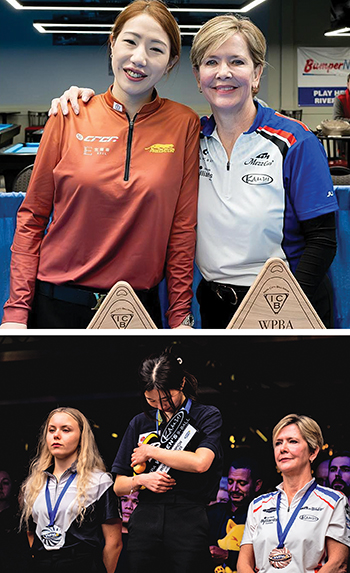 Fisher topped Wei (top) in Alabama, and ran third in the '25 World 9-Ball (above). The next year, Allison took her talent to the Women's Professional Billiard Association Classic Tour in America. “It was a breath of fresh air coming over here,” she says. “I was completely welcomed.” Her game translated well. “I thought it would take six months to adjust to 9-ball, learn the nuances. But I was like a sponge and won within two weeks, my second tournament.” She was the No. 1 woman player within a year. “Snooker was like my apprenticeship,” she says. Allison went on to dominate the women's circuit like Jean Balukas did generations earlier. Yet she was never fully satisfied. “Winning a tournament lasted just 30 seconds for me,” she says. “You get your trophy and that's it. On to the next one.” Her likely untouchable 80-plus career titles in snooker and pool combined led to her induction into the Billiard Congress of America Hall of Fame, the WPBA HOF, the World Snooker HOF, and the World Billiard Museum HOF. “I was never one of those 36 hours of practice types,” she adds. “I did my six hours and stopped. I was very regimented. It's why I think I didn't burn out.” Allison credits her massive success not so much to her natural talent but her relentless will to win. In fact, near the door of her home pool room hangs a quote about this from Muhammad Ali: “Champions aren't made in gyms. Champions are made from something they have deep inside them — a desire, a dream, a vision. They have to have the skill, and the will. But the will must be stronger than the skill.” “The last part of that quote is my favorite,” she says, “I don't have that kind of hunger anymore.” With a big chunk of Allison's life now gone — her playing, her practicing, her tournament hopping all over the world — she is wondering where the rest of her life will take her. How will she fill all those hours? How much will her Parkinson's get in the way? She plans to travel more with family. She has her passion projects: two cue-sports interview shows, Grace the Table, a TV series and streaming show that she hosts (which premiered on October 2 and appears on UP Faith & Family, Apple TV, Amazon Prime Video, and Roku) and Legends of the Cue, an ongoing podcast she co-hosts with Mark Wilson. “I love teaching. I want to continue teaching,” she says. “Or maybe I'll become a spokeswoman for Parkinson's. I know I want to find as many ways as I can to leave a legacy behind, to reach people as much as possible.” 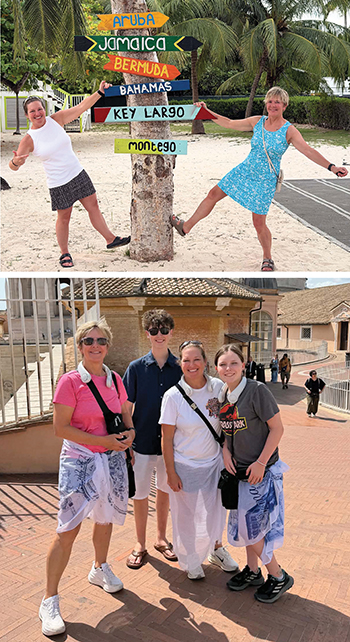 Fisher's immediate plans are to travel and make memories with Dee (top) and their kids, Pierson and Lilly (above). She knows the response to her grim news will be overwhelming. She is a beloved player like few others in the game. She is bracing herself for the outpouring of love that she knows will come. Just the thought of it, any mere mention, makes her bawl quickly and totally. To the younger generation of girls especially, she is the player they grew up idolizing — a motherly queen figure; to the older generation of women, she is the peer they most respected, admired, and liked. “I always believed in good sportsmanship,” she says. She was humble despite her dominance. “I never shoved anything into the faces of the players or fans. I tried always to be nice and kind to everyone.” She is a living legend, a walking statue; she is well-aware of that fact, devoid of any ego. “It was hard to quit,” she says, “when you know that you're inspiring others.” It's a late afternoon in New York City, West 29th street in Manhattan. Allison is in a 12th-floor production studio, simultaneously doing a photo shoot with A-list photographer Larry Busacca and being part of a still-in-development docuseries with Los Angeles-based filmmaker Ashley Archer, named Cue Queens, about four generations of female pool players. She is all dolled up with heavy makeup — mostly lipstick and blush — and changing into various high-fashion outfits, ultimately settling into a chic, blowsy two-piece beige-and-white one. Her hair is being brushed and teased and brushed some more. This is the glammed-up Allison Fisher, not the understated one dressed smartly in a vest and pants at tournaments. There are cameras and lighting equipment everywhere. There are five staff assistants hovering — with hand-held video cameras and clipboards; a gofer getting coffee and food; a make-up artist with a palette. Allison is, as always, the center of attention. She seems perfectly comfortable with that. 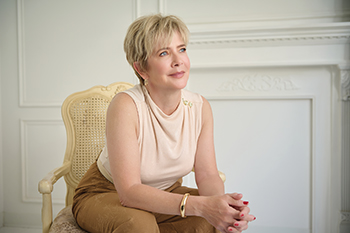 Fisher plans to carry the relentless will to win she used as a player to help push her forward. She took her medication earlier in the day. There are no noticeable signs of her Parkinson's. No tremors whatsoever — or she is doing a great job concealing them. She looks no different than the Allison we all know. She seems relaxed. She is smiling and cracking jokes. Reveling in the moment. Staying in the present. “I've always been good at that,” she says. “That's what I need to do.” This is Allison Fisher's life now: accepting her disease as best she can, doing what she needs to do by taking her meds, and moving on from playing pool — her lifelong comfort zone. There is still a whole lot of uncertainty, trepidation. In her weaker moments, she admits that it is “totally frightening.” It could easily go sideways. She could end up with tremors overwhelming her whole body. She could end up like Fox, walking with a cane or being bound by a wheelchair. She could suffer memory loss, crazy mood swings, and deep depressions. Then again, she could stay pretty much the same for decades. Who knows? Parkinson's is so unpredictable. She is trying not to get ahead of herself. She is trying not to think the worst. She is putting on a strong front - for herself as well as others close to her. She is on the lookout for a trial of an experimental drug for PD. She is not rushing. She will do this at her own pace, on her own terms: wisely, patiently, and with total control. She wants to ensure whatever new drug she takes is the right one. “The way things are moving, we might find a cure,” she says. She takes a second for a moment of reflection. “It gives me…” she says finally, letting out a long sigh, “a little bit of hope.” 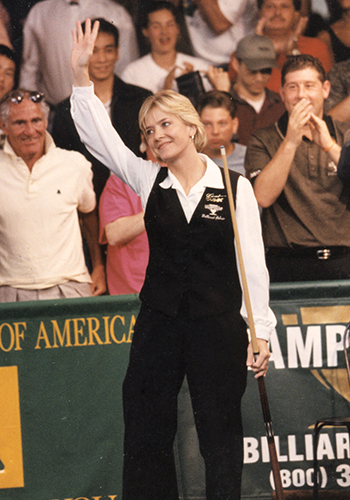 Fisher's career may well stand the test of time as greatest ever. |
|
Since 1978, Billiards Digest magazine has been the pool world’s best source for news, tournament coverage, player profiles, bold editorials, and advice on how to play pool. Our instructors include superstars Nick Varner and Jeanette Lee. Every issue features the pool accessories and equipment you love — pool cues, pool tables, instruction aids and more. Columnists Mike Shamos and R.A. Dyer examine legends like Willie Mosconi and Minnesota Fats, and dig deep into the histories of pool games like 8-ball, 9-ball and straight pool.
Copyright © 1997 - 2025 Billiards Digest
All Rights Reserved
Luby Publishing, Inc.
310 Busse Highway PBM #319 | Park Ridge, IL 60068
Phone: 312-341-1110 | Fax: 312-341-1469