|
|
Current Issue
Next Page >
Three Days in Havana
The story of Alfredo De Oro's glorious return to his homeland - and the controversy that followed.
Story by R.A. Dyer
|
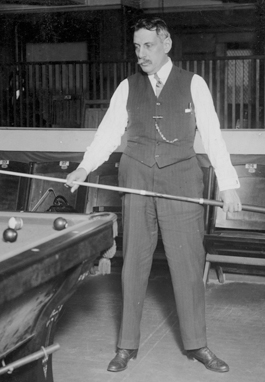
| De Oro's return in 1918 was his first step on Cuban soil in 25 years. (Photos courtesy The Billiard Archive) |
THE YEAR: 1918. The date: Jan. 5th. A Saturday. Alfredo De Oro, the great cue artist, has just arrived at the Port of Havana. A small group of fans await him anxiously at the foot of the gangplank.
It has been 25 years for the old Cuban, 25 years of not seeing his beautiful native land. And he does so now, finally, with a single-minded purpose: to defend his crown. The reigning three-cushion champ has returned to play a match against an old friend, the American Chesbrough S. Otis, to be conducted over three days on the stage of Havana's finest theater.
De Oro waves and smiles. There's excitement in his eyes - excitement to be home, finally - but something else lurks there as well. The graying star feels his years, walks with a stoop, and nurses a bad hand. His whole body sags - sags as if the burden of his nation's expectations are weighing down upon him.
There's excitement behind the old Cuban's eyes, certainly, but something else as well. Call it trepidation.
Welcome Back to Untold Stories. This month's edition I devote to De Oro's dramatic three-day defense of his championship in Havana, Cuba. The match, conducted between January 10th and 12th in 1918, is still remembered today as one of the most dramatic in the history of three-cushion billiards. It also ended in controversy.
I first came across a reference to this extraordinary event while perusing old articles from the New York Times. From there I found more references in various extinct newspapers, including articles from old copies of the Amsterdam Evening Recorder and the New York Morning Express. But it was within the stacks of the Latin American Collection at the University of Texas where I stumbled upon the real gold mine. There, buried in yellowing, nearly 100-year-old copies of El Mundo, I found extensive references to the hero's welcome afforded to De Oro in Havana, a reference to a letter that he carried from his wife, and rare direct quotes. I also found references to the match in the English-language newspaper, The Havana Post, albeit less extensive ones.
To put this event in context, keep in mind that De Oro stands now among the very best players, ever, to play pool or billiards. The Cuban grand master amassed more world championships than any other cueist, ever. He is the only player to have simultaneously held the three-cushion and pocket billiards titles on two separate occasions. As my friend Mike Shamos notes in a 1985 edition of Billiards Digest, De Oro "beat world champions at all the American pocket billiard games, English billiards, pyramid pool and three-cushion caroms on tables varying in length from 10 to 12 feet."
But when he stepped off that steamship in 1918, it was clear that his best years were already behind him. Born in 1863 (in Manzanillo, Cuba), the old war horse now was pushing 55. Retirement loomed just ahead. De Oro also was recuperating from an injury to his right hand that made it impossible for him to put much pressure on it. He had agreed to play in Havana only as a favor to the Cuban government, which recently had assigned him a $150 per month old-age pension. But counter-intuitive as it might seem, even playing before an enthusiastic crowd of countrymen might count against him.
It was De Oro's first time back since Oct. 4, 1893, and the city and nation had changed dramatically. A tour by motorcar left the usually gregarious De Oro nearly speechless. His wife, writing before the match to a relative in Cuba, warned that the excitement and nostalgia might be too much for him to bear. "I fear that the great emotion that he will have there, and the small time he has had to rest, will damage his game," she said. "I ask God that he give him victory, although it might be his last victory ever and that he would then have to retire. If he wins this game there, it will be the most glorious of his life. Will he win it? God willing!"
Next Page >
Top |
|