|
|
Current Issue
Next Page >
Learning from Experience
After three decades with BD, George Fels offers 30 tips (and a bonus!) that will pay immediate dividends.
|
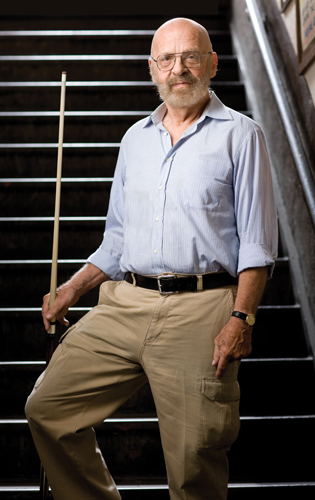
| George Fels, on the steps to Chicago's legendary Chris?s Billiards. (Photo by John Gress) |
14.1 (AND GENERALLY)
1. The esteemed Jimmy Reid, and a few other teachers here and there, suggest "Keep the cue moving" in your pre-stroke routine. But the majority of qualified instructors advocate a pause in there someplace. Jerry Briesath thinks the pause should come after the final practice stroke, just before the actual delivery; others favor a pause at the top of the backswing, in the manner of the late Cisero Murphy but not that exaggerated. There's little question that that pause does help develop playing rhythm.
2. If you do any practice drill involving lining object balls across the table, that line should always be halfway between the cue ball and your intended pocket(s). Think about it: The closer the object ball becomes to either the cue ball or the pocket, the less challenge there is to the shot. Halfway in between maximizes that challenge, hence more productive practice.
3. When experts play 14.1, close to 90 percent of the scoring will be in the bottom two pockets. But that doesn't mean you have to eliminate the other four, especially the far two corners. Willie Mosconi turned around and sent object balls there much more often than did his peers. And you know who won the lion's share of matches between Mosconi and peers.
4. Virtually any sensible change you try in your game is likely to produce short-term improvement. So unless you're completely happy, experiment with a bit more (or better, a bit less) cue-ball speed on your shots, a slightly faster or slower playing pace, a slightly shorter or longer bridge, etc.
5. And then there's the best of all those short-term improvement tips: Try chalking your cue with the hand you don't normally use. You'll very likely see a perceptible change in your play almost at once. We can get into why this should be so at some other time.
6. An object ball which reaches the "head" half of the table on your break shot cannot possibly help you (unless it lingers just outside the side pocket). So get to such balls good and early in your sequence. Once in a while, usually in an incorrectly run table, such a ball may become your key ball - but it doesn't figure to be a very good one.
7. Don't underestimate the value of break shots that are some distance removed from the rack. Balls close to the rack absorb a substantial percentage of your cue ball's speed, thus it's weakened in taking on the stack. But when the object ball is farther away, you can hit it a bit harder, the cue ball has time to pick up that secondary spurt of energy for your break, and the balls will scatter better.
8. Try not to "out-think" yourself by selecting your next-frame break shot too early in your sequence. The right point for that decision is when all the other balls are open. If you commit to such a ball before that, the chances are you'll take an unproductive route around it.
9. One exception to the last: If you select your break ball with one cluster remaining on the table - and you have a secondary break shot for that cluster in a direction away from, not toward, your break ball - proceed.
10. Even if you have a favored category of break shot (from the side, from behind, etc.), any object ball which allows the cue ball to contact one of the four corner balls in the rack should be productive for you. And remember, the balls in the two bottom corners of the rack can act as the apex of the triangle too, just as the head ball would if it were in place.
11. Seems odd to read, but you'll very likely get better at break shots if you forget about the 14 massed balls and just fire the break ball in, with your focus on object-ball accuracy and getting your cue ball into the clear. Too many players blow break shots that they'd be cinches to make if the rack weren't there. It's awfully tough to break your concentration up three ways.
12. Any time your cue ball takes on other object balls after striking the one you called, take a stroll around the table to examine your new layout - even if the adjustment seems very minor. It takes very little to turn a buried object ball into a dead shot, or for other forms of unplayable balls to become playable.
13. Always take that stroll immediately after your break shot, even if your next shot is obvious. It'll improve your mental game and help you see more efficient patterns.
14. There are at least two reasons for shooting balls on, or near, a side rail sooner rather than later in your sequence: 1) You're inviting mini-clusters along that rail if you don't, and 2) you want the rails clear for cue-ball travel.
15. One exception to the last: Always leave one object ball on the bottom rail until all the others are open. Your secondary break shot, or shots, might very well leave the cue ball down there, intentionally or otherwise; when that happens, you'll be grateful for the company.
Next Page >
Top |
|