You can’t let up for a second with this drill.
Here’s a great drill that will help improve your touch. You will learn to kill the ball, execute soft draw shot, soft punch run-throughs and stop shots. And all of this requires thinking ahead about where you need to place the cue ball for the next shot.
Making the ball, cue ball control and patterns will be in your thoughts at all times. That’s what I love about this drill. It will frustrate you but it’s also very rewarding. This drill has different levels to it, so we’ll start with Stage One — nine balls in any order.
It’s important to remember that you don’t need to follow exactly the route I take, or at least the route I took on this particular attempt. One of the things I like about this drill is that your route will change a lot. It’s important not to be annoyed or worried about changing direction and rerouting. It happens all the time. The key is getting back in line and having the knowledge and ability to do that.
The rules are that you can’t touch a rail, and you use the object ball as your cue ball. Also, balls cannot be pocketed in the side pockets.
Keep trying to beat your score. Even at Stage One, it’s a challenging drill.
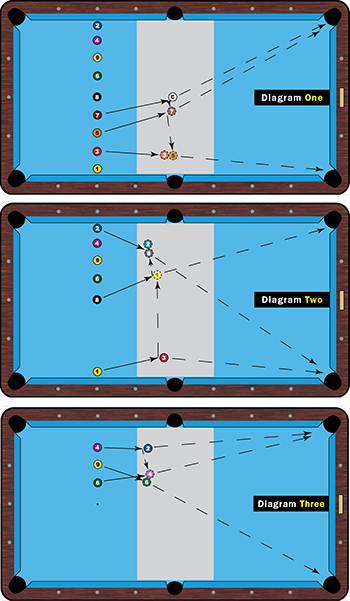
I like to start with the 7 ball (Diagram One) and play a soft kill shot with a little angle to come across, while already thinking about the angle I will need to leave for shot three. Always look three shots ahead.
I’m going to use the 5 ball as my cue ball to pocket the 7, using a punch draw with a smooth stroke, half tip below center. Taking a little risk here because I want to land well on the next ball. I’m already thinking about the angle I will need to leave on the 1 ball to shoot the 3 ball.
I’m trying to be nice and straight on 5 ball, using the 3 as my cue ball and leaving a nice angle for the 1 ball. Just below center, I use the 1 to pocket the 3 (Diagram Two), sliding across the center zone for the remainder of the balls. Make sure you don’t get any forward roll and that you get across the center of the table.
With the 8 ball, punch the 1 ball in and float over a bit. That will give you several options. In this case, I’m in perfect position. You may sometimes have to be slightly jacked up to shoot the 2 ball, but if it sits like this it will benefit you. Soft punch the 8 and come across with the 2 ball.
Now I can use the 4 ball to make the 2, (Diagram Three) punching across to give myself options for the last two balls. Ideally, I’d use the 6 ball first to pocket the 4. Make sure you look closely to see which balls connect the best. I used the 6 and pulled it across slightly, leaving the 9 ball as the cue ball for a straight in shot on the 6.
What I like about this drill is that by taking the side pockets out of play, each shot can be missed. You can’t let up at all with your focus. Losing that concentration will cost you with this drill.

Once you’ve aced this test, move onto Stage Two (Diagram Four), which is using all 15 balls across the table and shooting in any order. For Stage Three (Diagram Five), line up nine balls (or 15) and shoot them in rotation.