Don’t be fooled, this drill can frustrate you.
This line-up drill is suitable for all levels. And don’t be fooled by the layout. It can frustrate you at times. The problems usually creep in after the first three or four shots. You will quickly understand the significance of proper pattern play — using the rails and understanding their value in playing rotation games.
Speed control and focus are very important. The layout is designed to give you a few breather shots as well as shots on which the cue ball must travel and rails come into play.
Position the balls as shown and, starting with ball in hand, run the balls in rotation. As always, no bumping other balls.
There are many different ways to approach this drill, most of which will be dictated by where you land after each shot. Assume you are going to have to change plans along the way. The benefit is in making you figure out the correct path and percentages. Once you get that rhythm, everything will improve.
Here’s how I went through the drill.
Judging cue ball path and speed is easier with follow, so use a tip of high right english to make the 1 into pocket C, following off the long rail and leaving a nice angle on the 2. Use left english on the 2 ball. The angle here was perfect to use the short rail and long rail just before the side pocket, allowing you to come into a nice line for the 3. It’s vital to leave a nice angle on the 3.
I have a nice natural angle for a one-rail shot from the 3 ball, going straight up table. This might be the key shot in the whole drill. This angle is too steep for a punch draw, so I’m keeping it simple. Just a tip of right English.
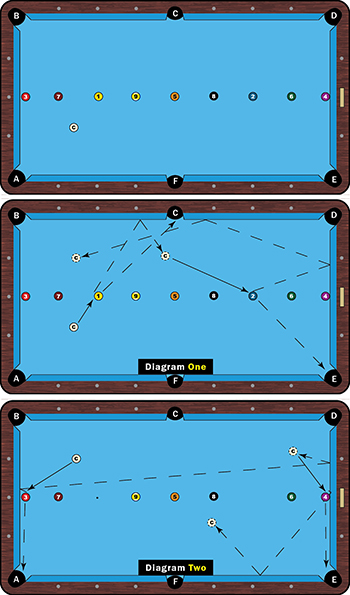
There are a couple options here on the 4 ball. I’d advise against playing for the side pocket (C) on the 5, as there is a lot of traffic. If you get the wrong angle on the 5, getting on the 6 ball will be really difficult. Playing for the 5 in the corner (pocket B) gives you greater margin for error and more options. High cue ball with 1-2 tips of right.
I got perfect on the 5 ball with a natural angle to the 6. Even if the cue ball was straight in, I could draw straight back a little. Remember, in these situations, the corners help you more than the side pockets. It may be a slightly more difficult shot, but the rewards are bigger. I just punched the cue ball here. No english.
I’ll use a punch shot with a half tip of left on the 6 ball, come before the side pocket, staying online and giving myself lots of room for error. Again, the second rail is your friend on these types of shots.
There’s plenty of angle on the 7 ball. You have two options: You can go forward with one rail, or do what I did here, which was a punch draw with half a tip or right english. Use the two rails to come into line for the 8 ball. At least, that was my approach.
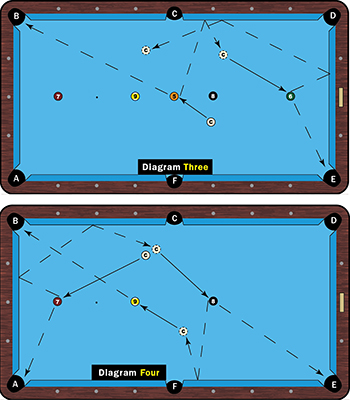
There’s lots of room on the table now but stay focused. I’m in good position to just punch it in, use the side rail and come out for a nice, easy 9 ball.
What you’re left with is a nice punch shot to finish.
This drill my frustrate you at times but you will also love it. It’s a great drill for all levels.