The wrong start will lead to an early end to your pattern play.
Recently, I watched a pro player start into a rack but he played the first shot wrong. That decision snowballed, leading to a missed finish.
It can happen to anyone, but what separates the best from the rest is consistency, recognizing the right patterns, and understanding the correct lines.
Let’s look at Diagram One. The player has ball in hand after the break. Many players would pocket the 1 ball simply because it’s close. That works half the time, but it doesn’t always leave the right angle on the 2 ball.
The player made that choice, landed short, then overran position on the 2 and ended up snookered on the 3.
Let’s try it the proper way.
First, whenever possible look to move the cue ball forward. It’s easier to control direction and speed. Play the 1 ball into pocket A (Diagram Two). This creates a better line for the next shot.
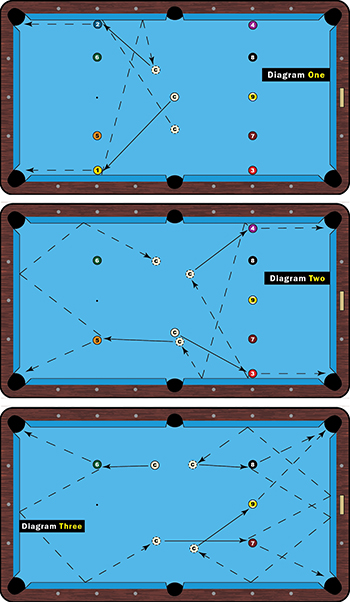
Use a punch stroke on the 2 to send the cue ball across two rails, leaving the proper angle and a generous landing zone on the 3 ball. From there, use about one tip of left english and two rails to reach the ideal line for the 4.
On the 4 ball, draw with about half a tip of right. There’s plenty of room here, so coming slightly short is perfectly acceptable. For the 5 (Diagram Three), draw with left at medium speed, aiming to reach the top side of the 6. This makes position on the 7 much easier. Use a little right english and send the cue ball around three or four rails. This provides natural position on the 7 while keeping the 8 out of the way.
I’d use plenty of left english to reach the top side of the 8, setting up a natural two-rail route toward the 9. On the 8, use high left and let your stroke out, bringing the cue ball into the line for the 9 with plenty of margin for error.
Good pattern play is about finding the right lines and giving yourself large landing zones. Think beyond the ball you’re shooting. Plan where the cue ball needs to go next.