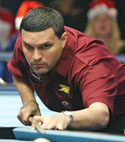

A longtime teaching pro at Amsterdam Billiard Club in New York City, Tony has dozens of regional and national titles to his name, including the 2004 BCA Open Championships.
I’D BET that a majority of pool players wish they could get to the table more often. Casual league players who play a few times a month probably wish they could practice an extra Tuesday night here and there; more invested students of the game might want to play two hours a night instead of one. Even I find myself wishing I had more time to work on my game.
Between running my tour, giving lessons, traveling to and from events and the rest of my day-to-day responsibilities, I’m always searching for a little extra time to sharpen — or, at a minimum, maintain — my skills. But despite my best efforts, I noticed one area of my game that was deteriorating. I realized that my draw stroke was not where I wanted it to be. I was struggling to execute as I had come to expect, so I refocused myself to strengthen this part of my game.
One way to find a solution to a problem is by experimenting during practice time. For me, I started fooling around with my approach to draw shots. Instead of lining my cue tip directly even with the point of contact on the cue ball during my practice strokes, I kept it really low, just barely above the cloth. As I stroked my cue, I kept the cue tip just a hair above the table. Then, during the delivery of my final stroke, I would raise the tip right before impact (so I wouldn’t miscue by hitting too low on the cue ball).
This approach to draw shots is pretty common among Filipino and Taiwanese players, but I had never tried it before. I’d always been taught to keep the cue directly level with the contact point. But during that initial practice session, I was able to get the results I wanted. It was a surprise at first, but now, after working with it for two weeks, I’ve found that I’m drawing the ball just as I should.
If you want to work on developing a stronger draw stroke, set up the balls as they are in Diagram 1, with the object ball a diamond from the corner and your cue ball another diamond and a half beyond that. Pocket the shot repeatedly, seeing what stroke or what thought pattern or even what feeling results in the most draw on the cue ball.
The point I’m trying to make is that it’s OK to experiment when you’ve got the time. When you have some time to practice, try different things and see what maximizes results and minimizes effort. One hint for your experiments: Bring a little notepad with you to the table, so you can write notes to yourself. These scribbles will help you remember what worked and what can be ignored.
Since 1978, Billiards Digest magazine has been the pool world’s best source for news, tournament coverage, player profiles, bold editorials, and advice on how to play pool. Our instructors include superstars Nick Varner and Jeanette Lee. Every issue features the pool accessories and equipment you love — pool cues, pool tables, instruction aids and more. Columnists Mike Shamos and R.A. Dyer examine legends like Willie Mosconi and Minnesota Fats, and dig deep into the histories of pool games like 8-ball, 9-ball and straight pool.