I don’t think any aspect of the game has grown — exploded, even — in recent years more than the jump shot. It has become a critical element in the game and the levels of precision that players have reached is nothing short of astonishing. Players today jump not only with pocketing accuracy but also with the added value of playing position accurately.
That said, the jump shot can still be pretty intimidating for a younger or newer player. But fear not. Most of your fear comes from a lack of understanding. The key thing to remember is that while your stroke is certainly different on a jump shot than on a normal shot, there are many elements of that stroke that are common to both.
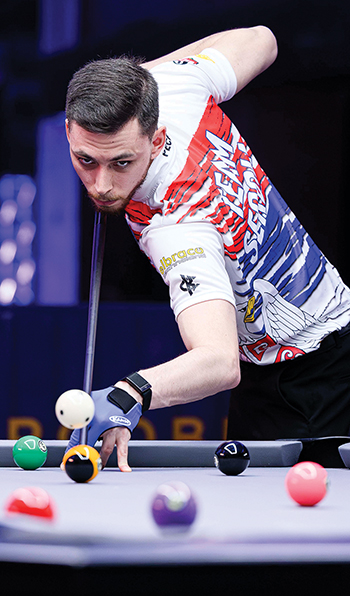
For starters, just like with your normal stroke, you want to remain centered over the cue ball. Of course, the butt of your cue will be elevated, which will force you to bend your bridge arm and lean your upper body forward. This will put more weight on your front foot. In the end, though, the result will be balance, just like your normal stance.
Your back arm should form a 90-degree angle for jump shots, just as it should on normal strokes. Your forearm should be perpendicular to your cue, all the while keeping your wrist, forearm, upper arm and shoulder lined up with your cue.
Aiming is also very similar to your normal shot. First, find the exact contact point on the object ball that you want to hit. Then shift your focus to where to hit on the cue ball to send it to that point. Ideally, you want the cue ball to hit the object ball and the table at the same time. This can be contact on the fly or when rolling if it’s a longer shot. Cue ball contact is much more volatile if the cue ball is bouncing when it strikes the object ball.
Finally, just as with a normal stroke, you want to keep your body and head steady as you deliver the cue to the cue ball.
Of course, there are other nuances to the jump shot, but the key is to get you started on a path that allows you to approach these shots without being intimidated.