What player doesn’t love ball in hand! It’s a free pass to run out (or, sometimes, to play a lock-down safety). Players tend to race to the table when they receive ball in hand, particularly when it occurs late in a rotation game rack. The player can’t wait to fire in the first ball.
The problem is, in their haste, players also tend to lose focus on how exactly they want to complete the run out. And more often than players would like to admit, they blaze away at that first shot only to discover that they are immediately out of position for the remaining balls.
One way to avoid this is to actually take more time observing the table when you get ball in hand than during one of your normal turns at the table. Another way, if the situation presents itself during practice, is to ask a better player how they might play the first shot. You always want to weigh all options.
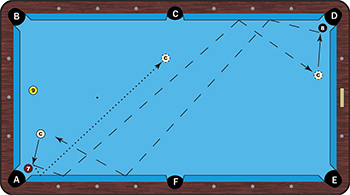
The diagram is a good example of a ball in hand run out that looks impossible to botch — at least on the surface. Not only are there just three balls remaining, but the first two (7 and 8) are literally dangling in the jaws of opposite corner pockets. How, you may ask yourself, could you not get out from here?
Easy. Most amateur players, thinking the less cue ball movement the better, will bunt the cue ball from the 7 one rail to the middle of the table (dotted line). After all, the 8 is a hanger, right?
The mistake here is that from this position, side pocket F becomes a huge problem going from the 8 to the 9.
The proper option is to go two rails from the 7 and leave the cue ball along the top rail. Now, using almost the same path back down table, the cue ball hits the second rail well below the side pocket and into position for the 9 ball. This is a much higher percentage option. Sometimes it’s better to go the extra rail to take pockets out of play.